Most people walk out of dental implant surgery thinking the hard part is over. It’s not.
What you eat in the days after surgery directly affects whether your implant heals properly. The titanium post in your jaw needs your bone to fuse around it — a process called osseointegration that takes three to six months. You cannot rush it, but you can absolutely disrupt it with the wrong food.
The right soft food diet for dental implants keeps the surgical site clean, controls inflammation, and gives your bone cells the protein and minerals they need. At Fort Worth Miller Dental, We walk every dental implant surgery patient through this before they leave the chair – but here’s a full day-by-day breakdown you can refer back to at home.
The One Rule That Overrides Everything: No Straws
No straws for at least the first week. Not for smoothies, not for shakes, not for anything.
Suction creates negative pressure that can dislodge the blood clot forming over your surgical site. Lose that clot and you get dry socket — exposed bone, intense radiating pain, and a delayed recovery that is entirely avoidable. Drink from a glass and tip it back slowly.
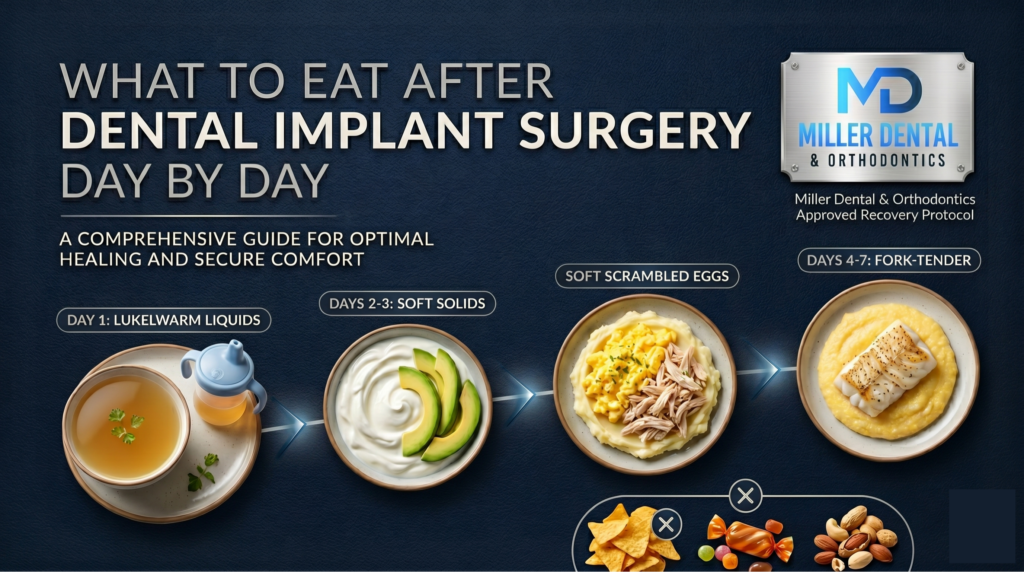
Day 1: Liquids Only
The first 24 hours are the most restricted. You’re still partially numb, the clot is forming, and swelling is just beginning.
Stick to:
- Lukewarm bone broth or clear soup (not hot — heat increases bleeding)
- Protein shakes or meal replacement drinks, sipped from a glass
- Apple juice or white grape juice — low acid, no pulp
- Plenty of plain water — anesthesia dehydrates you and hydration speeds tissue healing
No alcohol. Nothing hot. Nothing requiring any chewing. Keep everything on the opposite side of your mouth from the implant.
Days 2–3: Soft Solids Begin
Swelling peaks around Day 2 or 3. You can now introduce foods that require zero chewing pressure.
Good options:
- Greek yogurt or cottage cheese — high protein, high calcium, both useful for bone repair
- Soft-scrambled eggs — cook them pale and barely set, not rubbery
- Silken tofu or hummus (smooth, no chunks)
- Mashed banana, mashed avocado, or applesauce
Still lukewarm or room temperature on everything. Still no straws.
Days 4–7: Fork-Tender Foods
Peak swelling has passed. You can handle anything a fork can crush with light pressure.
Add in:
- Overcooked pasta (macaroni cooked well past al dente)
- Lukewarm oatmeal with honey or smooth nut butter
- Mashed potatoes or mashed sweet potato — no skins
- Steamed carrots or butternut squash, cooked until very soft
- Flaky white fish (cod or tilapia) or finely shredded chicken moistened with broth
This is the stage where post-implant nutrition actually moves the needle on healing speed. Aim for 60–80 grams of protein per day — your bone and gum tissue are rebuilding around the clock.
Week 2 and Beyond
Most patients feel much better by Week 2, which is exactly when they get careless. Surface tissue heals faster than bone. The implant can feel fine while osseointegration is still in early stages underneath.
A simple test: press your tongue gently against the surgical area. Any sharp pain or pulsing means you’re not ready to advance yet.
You can start adding:
- Soft sandwich bread (interior only — no hard crusts)
- Pancakes or waffles softened with butter or syrup
- Well-cooked beans and lentils
- Ripe melon, cut small
Most patients return to a normal diet somewhere between weeks three and six. Your surgeon’s specific guidance overrides this general timeline.
Foods to Avoid After Oral Surgery
Skip these completely for the first two weeks:
- Crunchy: Chips, popcorn, nuts, crackers — fragments lodge in stitches
- Sticky: Caramel, taffy, gum — can pull at stitches or the healing abutment
- Spicy: Hot sauces and peppers chemically irritate the incision
- Acidic: Citrus, tomatoes, vinegar-based dressings — lower the pH around the wound
- Seeds: Berries with seeds, poppy bagels, sesame — nearly impossible to rinse out of stitches
- Alcohol: Thins the blood, interferes with antibiotics, blunts immune response
A Few Things That Speed Recovery Beyond Diet
- Saltwater rinses from Day 2: Half a teaspoon of salt in warm water, held gently — don’t swish hard
- Sleep elevated for the first few nights to reduce swelling
- No smoking: It constricts the blood vessels that feed healing tissue and is one of the leading causes of implant failure
- Cold packs Day 1, gentle warmth from Day 3 onward
Frequently Asked Questions
Q: When can I drink coffee after dental implant surgery?
Wait until Day 2, and when you do, make sure it is lukewarm — not hot. Heat dilates blood vessels and can restart bleeding. Caffeine also has a mild vasoconstrictive effect at high doses, which is not ideal in the early healing phase. Skip the extra-strong cup for the first week.
Q: Can I eat ice cream after dental implant surgery?
Yes — plain, soft ice cream is actually a reasonable choice in the first day or two because the cold can reduce local inflammation. Avoid anything with mix-ins: nuts, chunks of cookie, or candy pieces. Hard chunks create exactly the mechanical risk you are trying to avoid. Soft serve or a simple scoop of smooth gelato is the better option.
Q: When can I eat a burger again?
Realistically, two to three weeks at the earliest — and only if the bun is soft and you are not biting down on the implant side. A burger requires you to open your mouth wide and apply significant bite force. That pressure is fine once the initial healing is solid, but doing it too early risks micro-movement of the implant in the bone. When in doubt, ask your surgeon at your follow-up.
Q: What if I accidentally chewed on the implant side?
First: do not panic. One accidental bite does not automatically mean failure. Check for increased pain, fresh bleeding, or any unusual sensation at the site. If any of those appear in the hour after, call your surgeon. If you feel nothing unusual, monitor the area closely for 24 hours. Consistent, worsening pain after accidental chewing is worth a call. A single incident with no symptoms usually is not.
Q: Is it normal to not feel hungry after the surgery?
Yes. Pain medication often suppresses appetite, and the stress of the procedure itself reduces hunger signals temporarily. Even if you are not hungry, try to get in some calories from liquids and soft foods. Your body needs fuel to heal, even when you do not feel like eating.
The Bottom Line
Follow the timeline: liquids on Day 1, soft solids by Day 2, fork-tender by Day 4, and gradual expansion from Week 2 onward. The biggest mistake is advancing too fast because you feel healed. Feeling better and being healed are two different things at this stage.
If you notice pain that’s getting worse after Day 3, swelling that isn’t going down, or anything that feels off — call the office. At Fort Worth Miller Dental, we’re reachable at (817) 413-6000 (Fort Worth) or (817) 466-1500 (Arlington).